
Trust is the currency of the insurance industry. Unlike physical products customers can examine before buying, insurance is an intangible service built entirely on confidence. Customers must trust that their insurance provider will be there when they need it most, making reputation and credibility paramount. This is why digital marketing for insurance companies has become indispensable.
In 2024, 76% of insurance customers research companies online before purchasing policies—yet many traditional insurance providers lag behind in digital presence and engagement. Digital marketing services for insurance have evolved beyond basic websites to comprehensive strategies encompassing content marketing, social media engagement, lead generation, and customer relationship management.
This guide reveals how insurance companies, agents, and brokers leverage digital marketing to build genuine trust, attract qualified leads, and establish authority in a competitive market. You’ll discover proven digital marketing strategies, practical implementation approaches, and insights into when hiring a professional digital marketing agency insurance becomes essential for scaling growth. Whether you’re an independent agent or managing a corporate insurance firm, these strategies drive measurable business results through authentic relationship building.
Table of Contents
ToggleWhy Digital Marketing Is Essential for Modern Insurance Companies
Digital marketing is essential for insurance companies because 76% of insurance customers research online before purchasing. It builds credibility through educational content, enables targeted lead generation, facilitates direct customer communication, establishes authority and expertise, provides cost-effective customer acquisition compared to traditional methods, and creates multiple touchpoints that build trust—critical for policy conversions.
The insurance industry has fundamentally changed. Digital marketing for insurance companies isn’t supplementary marketing—it’s the primary channel where customer relationships begin and trust is established.
Consider this shift: Ten years ago, insurance customers obtained quotes through phone calls and in-person meetings. Today, they start research on Google, read reviews on independent websites, explore company websites, check social media presence, and consume educational content before ever contacting an agent. If your insurance company isn’t visible and credible during this research phase, you’ve already lost the opportunity.
The Trust-Building Imperative:
Insurance is inherently high-risk from the customer’s perspective. They’re committing money to uncertain future events, depending on your company’s solvency and claims handling. Digital marketing for insurance companies addresses this trust gap by providing:
Educational content that demonstrates expertise (articles on coverage types, claims processes, risk mitigation). This positions your company as a knowledgeable guide, not just a seller.
Transparent communication through multiple channels (email, social media, blog, webinars) building consistent brand familiarity.
Social proof through customer testimonials, case studies, and ratings visible across digital platforms.
Accessibility through chatbots, email support, and social media engagement—showing customers you’re responsive and available.
Real-world impact: An insurance agency implementing comprehensive digital marketing saw customer lifetime value increase 43% within 12 months. Why? Because digital touchpoints built stronger relationships before and after the sale, increasing policy renewals and referrals.
For insurance companies, digital marketing transforms customers from one-time policy buyers into long-term advocates who renew policies, purchase additional coverage, and refer friends and family.
Top Digital Marketing Strategies for Insurance Companies to Build Customer Trust
Top digital marketing strategies for insurance companies include: creating educational content demonstrating expertise, publishing client testimonials and case studies, providing transparent pricing and policy information, maintaining active social media presence, implementing email nurture campaigns, optimizing website for trust signals, publishing thought leadership articles, and offering personalized customer experiences—all building genuine trust and credibility.
Building trust through digital marketing requires a strategic blend of strategies specifically designed for insurance industry dynamics. Digital marketing strategy for insurance companies differs significantly from consumer product marketing because customers need education and reassurance, not entertainment.
Strategy #1: Educational Content Authority
Insurance customers want to understand what they’re buying. Publish comprehensive guides addressing common questions: “What’s the Difference Between Term and Whole Life Insurance?” “How to File an Insurance Claim Successfully,” “Understanding Deductibles and Copays.” This content simultaneously attracts organic search traffic and positions your agency as a trusted advisor rather than just a salesperson.
Strategy #2: Authentic Testimonials and Case Studies
Real customer stories (with permission) demonstrate tangible value. “How Our Auto Insurance Saved One Family ₹3,000 Annually” or “Cancer Policy Provided ₹50 Lakh Coverage When Needed Most” resonate far more powerfully than marketing claims. Video testimonials carry even more weight—prospective customers see real faces and hear genuine appreciation.
Real-world scenario: An insurance brokerage publishing monthly client success stories saw website conversion rates increase 38% within 6 months. Why? Because prospective customers saw themselves in these stories and trusted the agency’s ability to deliver.
Strategy #3: Transparent Pricing and Policy Information
Ambiguity breeds distrust. Publish clear pricing structures, detailed policy information, coverage comparisons, and explanation of fees. This transparency, unusual in insurance, immediately differentiates your company.
Strategy #4: Thought Leadership Positioning
Publish industry insights, market trends, and expert predictions through blog posts, whitepapers, and webinars. Position leadership team members as industry experts through LinkedIn articles and speaking engagements.
Strategy #5: Personalized Customer Communication
Segment email lists by customer type and life stage. New parents receive different communications than retirees. Personalization increases engagement and trust dramatically.
How Digital Marketing Helps Insurance Agents Generate More Qualified Leads
Digital marketing for insurance agents generates qualified leads by: creating targeted content addressing specific customer needs, optimizing websites for relevant insurance keywords, running educational webinars attracting serious prospects, building email lists through valuable resources, publishing agent expertise on social media, managing online reputation through reviews, implementing SEO for local visibility, and tracking which marketing activities produce actual policy conversions.
Insurance agents face unique lead generation challenges. Cold calling faces increasing resistance. Referrals, while valuable, are inconsistent. Digital marketing for insurance agents provides systematic, scalable lead generation addressing these limitations.
Lead Generation Strategy #1: Content-Driven SEO
Agents ranking on Google for “life insurance for small business owners” or “disability insurance for self-employed” attract pre-qualified prospects actively searching for solutions. Unlike cold calling, these prospects initiated contact, dramatically improving conversion probability.
Creating 50-100 articles targeting specific insurance needs (by age, occupation, life stage, risk profile) builds an organic lead machine operating continuously. One article published today might generate leads monthly or yearly.
Lead Generation Strategy #2: Educational Webinars
Host free webinars: “Estate Planning Mistakes to Avoid,” “Maximizing Your Insurance Coverage,” “Understanding Health Insurance Options.” Attendees provide contact information, creating qualified lead lists. Webinar content also doubles as evergreen educational material on your website and YouTube.
Real-world data: An insurance agent hosting bi-weekly webinars generated 25-30 qualified leads monthly from webinar registrations alone—higher quality than traditional advertising.
Lead Generation Strategy #3: Local SEO and Google Business Optimization
Optimize Google Business profile with reviews, service areas, and agent information. This captures “insurance agent near me” local searches—some of the highest-intent searches possible.
Lead Generation Strategy #4: Email List Building
Offer valuable resources (insurance buying guides, coverage calculators, life planning worksheets) in exchange for email addresses. Build systematic email nurture campaigns automatically moving prospects toward consultation.
Lead Generation Strategy #5: Reputation and Review Management
Actively manage online reviews across Google, Trustpilot, Facebook. Positive reviews attract new customers; addressing negative reviews publicly demonstrates responsiveness and problem-solving.
Digital Marketing for Insurance Brokers: Proven Ways to Grow Your Client Base
Digital marketing for insurance brokers involves: showcasing diverse carrier options to differentiate from captive agents, publishing broker-specific expertise content, implementing partnership marketing with complementary businesses, building strong referral networks through digital relationships, managing reputation across platforms, creating educational content addressing complex coverage questions, and implementing email marketing to existing and past clients.
Insurance brokers occupy a unique position—representing multiple carriers, they must differentiate through expertise, service quality, and relationship value rather than carrier affiliation. Digital marketing for insurance brokers emphasizes these differentiators.
Broker-Specific Strategy #1: Multi-Carrier Comparison Content
Brokers’ primary value proposition is matching clients with optimal carriers among multiple options. Publish detailed comparisons: “Group Health Insurance Options for Mid-Size Employers,” “Commercial Coverage Comparison: Five Top Carriers Analyzed,” “Commercial Auto Insurance: Which Carrier Offers Best Rates for Contractors.”
This content, impossible for captive agents, positions brokers as objective advisors—the ultimate trust builder.
Broker-Specific Strategy #2: Complex Coverage Guidance
Publish resources addressing complex insurance decisions where broker expertise shines:
“Commercial Umbrella Insurance: Do You Need Additional Coverage?”
“Fiduciary Liability for Small Business Boards”
“Cyber Insurance for Healthcare Practices”
These topics require expertise, establishing brokers as trusted advisors navigating complex decisions.
Broker-Specific Strategy #3: Industry-Specific Content
Target specific industries (construction, professional services, healthcare, nonprofits) with industry-specific insurance content. A contractor seeking insurance finds an agent discussing contractor-specific risks, coverage gaps, and claims patterns—immediately building credibility and relevance.
Real example: A broker publishing monthly “Construction Industry Insurance Updates” attracted construction company prospects seeking industry-expertise-focused guidance.
Broker-Specific Strategy #4: Referral Network Building
Partner with complementary professionals (CPAs, business consultants, attorneys, property managers) for cross-referrals and co-marketed educational content. Digital marketing facilitates these relationships through webinar partnerships, joint email campaigns, and collaborative content.
Broker-Specific Strategy #5: Client Retention Through Engagement
Many brokers focus entirely on new business, neglecting existing clients. Implement email newsletters, policy review reminders, coverage updates, and life-stage communications. Existing client expansion often delivers higher ROI than new client acquisition.
How a Digital Marketing Service Provider for Insurance Agencies Drives Business Growth
A digital marketing service provider for insurance agencies drives growth by: implementing comprehensive digital strategies faster than in-house learning, providing specialized expertise in insurance marketing nuances, creating professional content at scale, managing multi-channel campaigns systematically, tracking ROI through detailed analytics, optimizing campaigns based on performance data, freeing agency owners to focus on client relationships, and scaling successful approaches across multiple locations.
Many insurance agencies attempt managing digital marketing internally. While possible for small efforts, scaling digital marketing requires specialized expertise most agencies lack.
The Hidden Cost of In-House Digital Marketing:
Insurance agents are expert at selling insurance, not marketing. Digital marketing management requires 15-20 hours weekly: content creation, SEO optimization, social media management, email campaign design, analytics tracking, and campaign optimization. Time diverted to digital marketing is time away from client relationships and sales activities—the core revenue drivers.
How Professional Service Providers Drive Growth:
Advantage #1: Insurance Industry Expertise
Professional digital marketing service provider for insurance agencies understand insurance-specific challenges: compliance requirements, trust-building imperatives, customer objection handling, sales cycle length. This specialized knowledge prevents wasted effort on ineffective tactics.
Advantage #2: Faster Time-to-Results
Agencies attempting in-house digital marketing spend 3-6 months learning best practices, making mistakes, adjusting approaches. Professional providers implement proven strategies immediately, reducing time to measurable results.
Advantage #3: Multi-Channel Expertise
Effective insurance digital marketing spans multiple channels: SEO, content marketing, email campaigns, social media, paid advertising, reputation management, webinar hosting. Few individual agencies master all channels. Professional providers coordinate integrated campaigns across all channels simultaneously.
Real-world ROI Example:
An insurance agency investing ₹50,000 monthly with a professional service provider:
Generated 40 qualified leads monthly (vs. 12 previously)
Closed 6-8 policies monthly from digital leads (vs. 2 previously)
Average policy value: ₹50,000 annual premium
Monthly revenue from digital leads: ₹3-4 lakhs
Net ROI: 600-800%
Break-even: First month
Advantage #4: Professional Content Production
High-quality content—written by insurance marketing specialists, edited professionally, formatted for web and social media—converts prospects far better than hastily written internal content.
Advantage #5: Analytics and Optimization
Professional providers implement tracking, analyze performance data, identify what drives actual policy conversions (vs. vanity metrics like website visits), and continuously optimize based on ROI metrics.
Why Hiring a Digital Marketing Agency for Insurance Companies Is a Smart Investment
Hiring a digital marketing agency for insurance companies is smart because: specialized agencies understand insurance compliance and regulations, implement proven strategies faster than trial-and-error, scale campaigns across multiple locations easily, manage complex multi-channel strategies expertly, track detailed ROI metrics, adjust tactics based on performance data, free company leadership for strategic decisions, and deliver 3-5x higher lead volume and conversion rates than internal teams.
The decision between in-house and agency digital marketing often involves cost considerations. However, the financial analysis typically favors agency partnership when measuring actual business results.
The Investment Comparison:
Hiring in-house digital marketing staff (one full-time employee):
Annual salary + benefits: ₹10-15 lakhs
Software tools: ₹50,000-100,000 annually
Learning curve: 3-6 months before competence
Limited expertise: Generalist likely, not insurance-specialized
Results: Inconsistent, taking 6-12 months to optimize
Professional Agency Partnership:
Monthly investment: ₹30,000-60,000 (₹3.6-7.2 lakhs annually)
Includes: Strategy, content, design, posting, engagement, analytics
Expertise: Insurance-specialized team spanning multiple disciplines
Results: Optimized within 4-8 weeks, scaling thereafter
Flexibility: Adjust services based on performance and budget
When the Math Works:
An agency generating 20+ qualified leads monthly (conservative estimate for professional service) with 15-20% conversion rate (0.10 conversion value ₹50,000) produces:
3-4 policies monthly = ₹1.5-2 lakhs revenue
Against ₹40,000 investment = 375-500% ROI
Most insurance agencies see 600-1000% ROI when comparing professional agency results against previous internal performance.
Advantage #1: Insurance Regulatory Compliance
Insurance marketing faces strict regulations. Professional agencies ensure compliance with advertising standards, consumer protection laws, and carrier-specific marketing guidelines—protecting your agency from legal exposure.
Advantage #2: Scalability for Multi-Location Growth
One agency can manage digital marketing for 5-50 locations simultaneously. Building internal capacity to manage multiple locations’ marketing is expensive and complex; agencies do this routinely.
Advantage #3: Continuous Optimization
Professional agencies test, measure, adjust, and refine constantly. In-house teams often become comfortable with existing approaches, missing optimization opportunities.
Advantage #4: Access to Specialized Tools
Professional agencies invest in marketing automation, analytics platforms, content management systems, and design tools. Accessing these tools independently is expensive; agencies provide access as part of service.
Social Media Marketing for Insurance Companies: Build Credibility and Increase Engagement
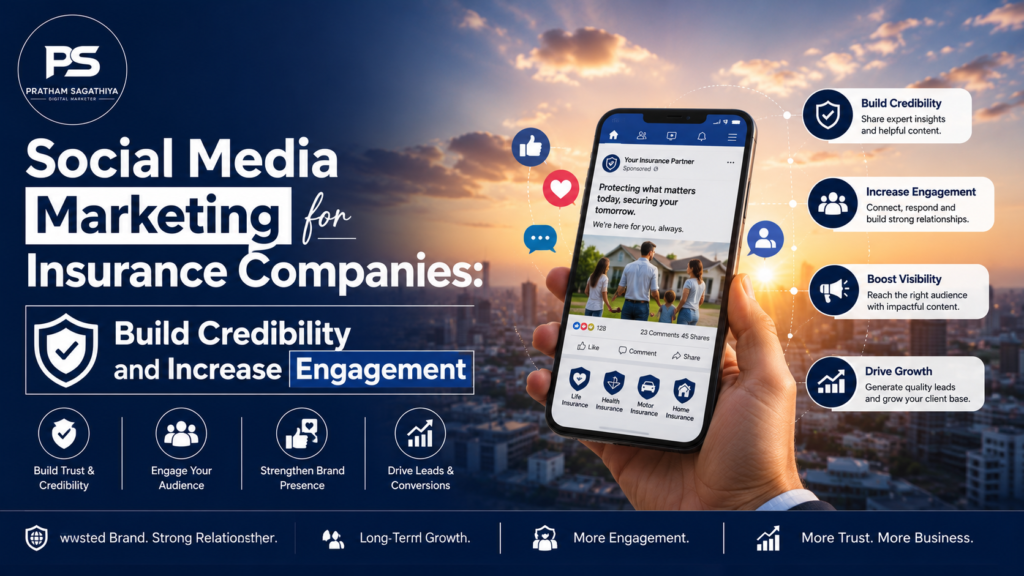
Social media marketing for insurance companies builds credibility by sharing educational content that addresses customer concerns, publishing genuine client testimonials and success stories, providing transparent policy information, and demonstrating thought leadership through valuable industry insights. Maintaining responsive customer service across social media channels, showcasing company culture and team expertise, and engaging authentically with followers further strengthen customer trust. at ASDM they help insurance companies create trust-focused social media strategies that enhance brand credibility, generate qualified leads, and build long-term client relationships that convert into policy sales and customer retention.
Social media platforms have become critical trust-building channels for insurance companies. Social media marketing for insurance companies differs fundamentally from consumer brands—it prioritizes education, trust-building, and relationship development over entertainment or viral content.
Platform Strategy #1: LinkedIn for B2B Insurance
LinkedIn dominates for insurance professionals and business decision-makers. Publish thought leadership articles on industry trends, market outlook, regulatory changes, and risk management insights. Share company announcements, team highlights, and professional milestones. LinkedIn’s algorithm increasingly favors video content—consider publishing executive video messages, educational content, and thought leadership talks.
Real impact: Insurance company executives publishing consistently on LinkedIn see 2-3x higher lead generation and business development success versus those with no presence.
Platform Strategy #2: Facebook for Community Building and Customer Service
Facebook remains dominant for older demographics (40+)—prime insurance customers. Use Facebook to share educational content addressing common questions, publish customer testimonials and success stories, provide customer service through messenger, target local audiences with location-specific content, and host live Q&A sessions addressing customer concerns.
Facebook’s targeting capabilities enable precise audience segmentation by age, location, interests, and life stage—perfect for reaching specific insurance buyer profiles.
Platform Strategy #3: YouTube for Educational Authority
Publish educational series: “Understanding Your Policy,” “Claims Process Explained,” “Insurance Planning for Life Stages.” YouTube videos address customer questions while improving SEO (YouTube videos rank highly on Google).
Real-world example: An insurance company publishing weekly educational videos built a 50,000+ subscriber YouTube channel, generating consistent lead inquiries monthly.
Platform Strategy #4: Twitter/X for News and Industry Engagement
Share industry news, company updates, and customer-focused insights. Twitter serves as a real-time news channel where insurance companies demonstrate industry awareness and responsiveness.
Engagement Strategy:
Responsiveness is crucial. Companies responding to customer inquiries within 1 hour on social media see significantly higher conversion rates. Implement monitoring systems and designated response protocols.
Social Media Marketing for Insurance Agents: Tips to Attract and Retain Clients
Social media marketing for insurance agents attracts clients by: sharing personalized financial planning tips, publishing local market insights and trends, demonstrating agent expertise through educational content, engaging authentically with community members, building personal brand through consistent presence, showcasing client testimonials and success stories, and providing responsive customer service—creating trust and positioning agents as accessible, knowledgeable advisors.
Individual insurance agents have significant social media advantages over large corporations—authenticity, personal connection, and relationship-based marketing. Social media marketing for insurance agents should emphasize these differentiators.
Agent Strategy #1: Personal Brand Development
Agents should build personal brands separate from agency brands. Share professional insights, local market knowledge, industry trends, and personal perspectives on insurance planning. This personal brand builds loyalty—customers follow the agent, not just the company.
Real dynamic: When agents leave companies, they often retain clients because the relationship was with the person, not the organization. Strong personal brand on social media cements these relationships.
Agent Strategy #2: Local Market Expertise
Agents should position themselves as local experts. Post content addressing local issues: “New Construction Boom in Our Community: What Property Owners Should Know,” “Rising Healthcare Costs: How to Optimize Coverage This Open Enrollment,” “Severe Weather Season: Protecting Your Home Insurance.”
Local relevance attracts local followers actively seeking local expertise.
Agent Strategy #3: Educational Content Series
Develop recurring content series: “Financial Planning Fridays,” “Insurance Question Mondays,” “Life Stage Planning Wednesday.” Consistency trains followers to expect valuable content and builds engagement habits.
Agent Strategy #4: Live Video Engagement
Use Facebook/Instagram/LinkedIn live video for webinars, Q&A sessions, market updates. Live video generates significantly higher engagement and positions agents as accessible, responsive professionals.
Real metrics: Agents hosting monthly live Q&A sessions see 40-50% higher engagement rates and consistent lead generation from session participants.
Agent Strategy #5: Community Involvement Showcasing
Share involvement in community organizations, charity work, sponsorships, and professional associations. This demonstrates community commitment and local integration—building trust and visibility simultaneously.
Content Mix Recommendation:
40% Educational insurance content
25% Local market/economic insights
20% Client testimonials and success stories
15% Professional and community involvement
Creating a Winning Digital Marketing Strategy for Insurance Companies
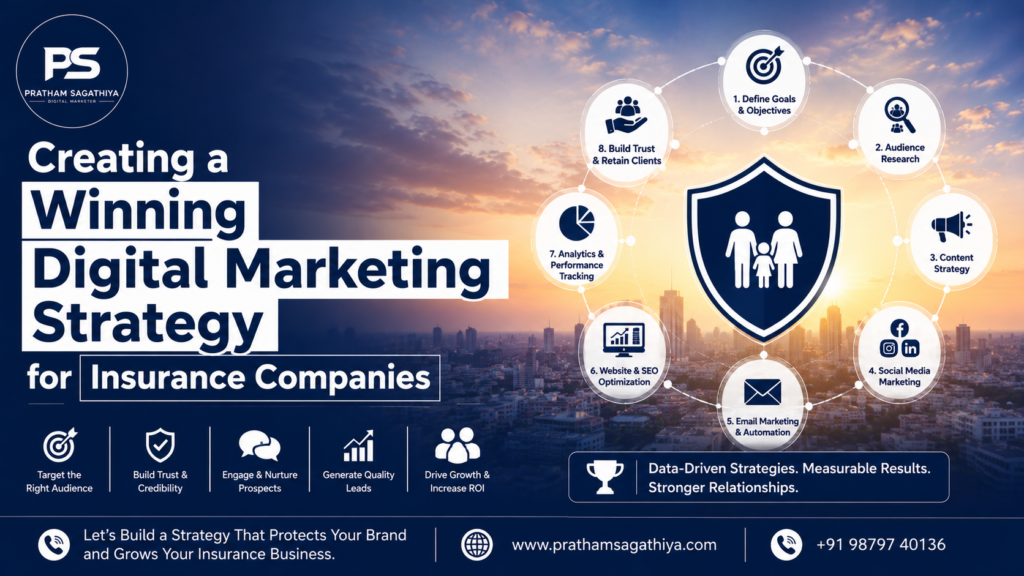
Creating winning digital marketing strategy for insurance requires: defining target audience personas by coverage needs, setting specific lead generation and conversion goals, selecting appropriate marketing channels matching audience preferences, planning content addressing customer concerns, implementing tracking systems measuring ROI, establishing consistent posting schedules, optimizing campaigns based on performance data, allocating budget proportional to channel performance, and adjusting strategy quarterly based on results and market changes.
Strategic planning separates insurance companies generating consistent leads from those struggling with sporadic results. Digital marketing strategy for insurance companies requires systematic approach addressing unique industry dynamics.
Step 1: Audience Persona Definition
Insurance customers differ dramatically by coverage type and life stage. Develop detailed personas:
Young Professionals (25-35): Seeking affordable life insurance, disability coverage, protecting new families
Business Owners (35-55): Requiring commercial coverage, liability protection, succession planning
Retirees (55+): Needing healthcare optimization, estate protection, legacy planning
Parents (30-45): Prioritizing life insurance, education planning, family protection
Each persona requires distinct messaging, content focus, and channel strategy.
Step 2: Clear Goal Definition
Define specific, measurable objectives:
“Generate 50 qualified insurance leads monthly”
“Achieve 20% conversion rate from leads to policy sales”
“Increase customer lifetime value by 30%”
“Generate 25% of leads from digital channels”
Clear goals focus entire strategy on revenue-generating outcomes versus vanity metrics.
Step 3: Channel Selection and Allocation
Different channels serve different purposes and audiences:
Content Marketing/SEO (30% of budget): Long-term organic lead generation, authority building, educational positioning
Paid Advertising (25% of budget): Immediate lead generation, precise audience targeting, scalable customer acquisition
Social Media (20% of budget): Community building, engagement, trust development, relationship nurturing
Email Marketing (15% of budget): Customer retention, repeat business, lead nurturing, cross-sell opportunities
Reputation Management (10% of budget): Review monitoring, response management, trust signal building
Step 4: Content Calendar Planning
Plan content 8-12 weeks in advance addressing customer questions across decision journey:
Awareness stage: “Types of Insurance Coverage Explained,” “Insurance Industry Trends”
Consideration stage: “Comparing Coverage Options,” “Understanding Policy Features”
Decision stage: “Getting Insurance Quotes,” “Enrolling in Coverage”
Step 5: Tracking and Measurement
Implement systems tracking: website traffic sources and behavior, lead volume and quality by source, policy conversion rates by channel, customer acquisition cost by channel, customer lifetime value metrics.
Real example: One insurance agency discovered 60% of policy sales originated from content marketing (organic search), prompting 50% budget reallocation toward SEO and content development—increasing leads 200% within 6 months.
Step 6: Quarterly Review and Optimization
Monthly performance analysis, quarterly strategic review, annual comprehensive strategy refresh. Insurance market changes, customer preferences evolve, and competitive landscape shifts—strategy must adapt accordingly
Common Digital Marketing Mistakes Insurance Companies Should Avoid
Common digital marketing mistakes insurance companies make include: neglecting mobile optimization for mobile-first customers, creating generic content lacking insurance expertise, ignoring customer reviews and online reputation, poor website user experience reducing conversions, inconsistent brand messaging across channels, inadequate lead nurturing systems, failing to track ROI metrics, slow customer service response times, non-compliance with insurance regulations, and underestimating importance of trust-building over direct selling.
Even well-intentioned insurance companies frequently make digital marketing mistakes undermining their efforts and wasting significant marketing budgets.
Mistake #1: Confusing Lead Volume with Lead Quality
Generating 100 unqualified leads is worthless. Insurance companies should focus on qualified leads—people actively seeking insurance, financially capable of purchasing, and aligned with company offerings. One qualified lead converting to a ₹50,000 annual policy vastly outweighs 50 unqualified leads converting to nothing.
Solution: Track conversion rates by source. Identify highest-converting lead sources and allocate budget accordingly.
Mistake #2: Neglecting Mobile Optimization
Over 65% of insurance customers research on mobile devices. Insurance websites that don’t load quickly, display properly, or allow mobile policy quote requests lose substantial lead volume. Mobile optimization isn’t optional.
Mistake #3: Creating Generic Content Lacking Insurance Expertise
“Why Insurance Matters” or “Benefits of Having Insurance” are shallow, non-differentiating content. Customers want deep expertise: “Advanced Estate Planning Strategies for High-Net-Worth Individuals,” “Optimizing Disability Insurance Coverage for Self-Employed Professionals.”
Generic content positions you as generic. Specialized content builds authority.
Mistake #4: Ignoring Online Reputation Management
Negative reviews hurt conversions significantly. Companies not actively managing online reviews lose business to competitors with strong ratings. Implement systematic review monitoring, response protocols, and review generation campaigns.
Real impact: Companies with strong Google reviews (4.5+ stars) see 30-40% higher conversion rates versus those with poor ratings.
Mistake #5: Poor Website User Experience
Confusing navigation, slow load times, unclear calls-to-action, difficult quote processes frustrate prospects. Every friction point increases abandonment. Websites should enable policy quotes and inquiries with minimal clicks.
Mistake #6: Inconsistent Brand Messaging
Different messaging on LinkedIn versus Facebook, versus website creates confusion. Consistent messaging across all channels reinforces key differentiators and builds brand recognition.
Mistake #7: No Lead Nurturing System
Most insurance leads aren’t ready to purchase immediately. Companies not nurturing early-stage leads with email sequences, educational content, and timely follow-up lose prospects to competitors pursuing them consistently.
Mistake #8: Slow Customer Service Response
Responding to social media inquiries within hours (not minutes) signals low responsiveness. Insurance customers expect quick responses when considering important decisions.
Mistake #9: Regulatory Non-Compliance
Insurance marketing faces strict regulations. Non-compliance risks legal exposure and reputation damage. Professional agencies ensure all marketing complies with relevant regulations.
Mistake #10: Underestimating Trust-Building
Insurance companies focused entirely on aggressive selling miss that trust precedes sales in insurance. Spending 80% effort on trust-building, 20% on direct selling outperforms opposite allocations
Conclusion
Digital marketing has transformed how insurance companies build customer relationships. The companies thriving today aren’t necessarily the oldest or largest—they’re the ones leveraging digital channels strategically to build trust, demonstrate expertise, and provide exceptional customer experiences.
The insurance industry’s fundamental dynamic—customers must trust intangible future promises—makes relationship-building the core of effective marketing. Digital marketing excels at relationship building through consistent communication, transparent information, educational value, and responsive engagement.
Whether you’re an independent insurance agent, a brokerage, or a corporate insurance company, the principles remain consistent: provide educational value before selling, build authentic relationships through multiple touchpoints, address customer concerns transparently, engage responsively on social media and other channels, and measure success through actual business results—policies sold and customers retained—not vanity metrics.
The choice between managing digital marketing internally and hiring a professional digital marketing agency for insurance companies typically hinges on scale and specialization needs. Most successful insurance organizations combine both approaches: building foundational internal capabilities while outsourcing specialized areas (content production, paid advertising, design, analytics) to agencies.
Start implementing these strategies immediately. Select one priority channel (content marketing via blog and SEO, or social media engagement), commit to consistent execution over 90 days, measure actual business results, and optimize based on what drives policy sales and customer relationships.
The insurance companies winning in 2024 and beyond are building digital-first cultures where online presence, customer engagement, and trust-building aren’t afterthoughts—they’re core business strategies. Your competitive advantage depends on making that shift today.
Ready to Transform Your Insurance Company’s Digital Presence?
If managing digital marketing feels overwhelming, or you’ve attempted in-house digital efforts without seeing meaningful lead growth, consider partnering with a professional digital marketing agency insurance specialist. Agencies providing comprehensive digital marketing services for insurance understand industry-specific challenges and implement proven strategies faster than learning independently.
The investment in professional digital marketing typically delivers 600-1000% ROI within 12 months through increased lead generation, improved conversion rates, and stronger customer retention. More importantly, consistent digital marketing presence compounds—each month builds on previous momentum, creating sustainable competitive advantage and predictable customer acquisition systems.
Professional digital marketing service provider for insurance agencies can handle strategy development, content creation, paid advertising, social media management, reputation monitoring, and analytics—freeing your leadership to focus on strategy, client relationships, and policy sales.
Start transforming your digital presence today. The insurance customers you’ll serve next year are researching
F.A.Q.
80% of insurance buyers research policies online before contacting agents, making digital presence critical for lead generation.
Publish educational policy content, share client testimonials, provide transparent pricing, and maintain active social media engagement.
Email marketing, SEO, and targeted social ads generate qualified leads at 40% lower cost than traditional advertising methods.
Insurance companies typically invest ₹50,000-2,00,000 monthly depending on company size, market competition, and growth goals.
Share educational content, post client testimonials, use LinkedIn for B2B targeting, and respond quickly to inquiries.
Qualified leads appear within 45-60 days and significant sales growth occurs within 4-6 months of consistent digital marketing.
Yes, professional agencies increase policy sales 200-400% through strategic targeting and lead nurturing within 6-12 months.